Sunday, January 16, 2011

My first Sunday Age story


The first time I was asked to write a children's story for the Sunday Age I was given some fairly strict parameters.
The editor had chosen three children's authors to write the stories. Andy Griffiths was doing humour and Alison Lester was doing a mermaid story, so could I please write something urban, preferably a school-setting, with a multicultural slant? Um, OK. In a week to arrive on your desk before Christmas? No problems. (eek!)
As it actually turns out I don't mind a bit of pressure, and as I've mentioned before, I love working within boundaries. I've noticed when I run writing workshops with kids, that they do, too. If you give a bunch of kids a pen and paper and say 'Write a story' they will all stare at you blankly, but if you say 'Write a story about a dragon, or a mud-fight, or the the most embarrassing thing you remember' you barely get the last word of your sentence out before they are madly scratching away. I'm the same. Give me some parameters and I can reign that wandering mind of mine in enough to know where to start.
I knew that I was being asked to write a multicultural story because I had published quite a few children's books with Asian-Australian characters, the 'Fang Fang' stories being the most well-known. Having grown up in South-East Asia myself, changing schools every two years and often arriving in a place where no one around me spoke English, I am often drawn to stories of 'the outsider'. I was more than happy to explore this theme again. However, because I knew Andy and Alison were getting to write funny and magical stories I was very wary of my story seeming all PC and earnest, so I decided to toss in a little magic myself.
This is my story:

The Wish

I walk out of the bedroom in my new school uniform and everybody cheers. Ma, Ba, Auntie May and Uncle Di. Even Nai Nai looks up from the television for a moment to clap her papery old hands together. Only cousin Betty sits in the corner of the lounge room and rolls her eyes to the ceiling.

“Aiya! So pretty!” Aunty May screeches, pinching my cheeks so hard that my eyes water. “Better than the Chinese school uniforms, huh? So much easier to clean.”

I tug Ma’s arm and pull her to one side. “Ma, please don’t make me go,” I beg. I’m trying not to cry in front of Cousin Betty but my throat feels so tight it’s like I’ve swallowed an orange.

“You’ll be fine Little Pumpkin Gourd,” Ma says, calling me by my Shanghainese name. "Cousin will look after you, won't you Magnificent Treasure?"

My cousin sighs. “They call me Betty, here, Auntie,” she says shaking her head and looking at Ma like she’s just a squashed up old dim-sim on the road.

I don’t like the way my cousin talks to my parents. We were all born in the same place. Just because she has lived in Australia for three years and can speak English doesn’t mean she’s suddenly grown an extra brain.

“OK, everyone in the car,” Uncle Di says, clapping his hands together and we all bustle towards the door. I drag my feet but Ma’s hand is like a claw in my back.

“Don’t make me lose face in front of your Auntie May,” she hisses in my ear.

Suddenly, Nai Nai makes a noise. Everyone turns around surprised because Nai Nai rarely talks. She just sits in front of the TV watching the ads all day and sipping thimble-sized teacups of bitter black herbs. Nai Nai raises a shaky arm and points at me. I look at Ma who puts the claw back into my back, but this time pushes me towards Nai Nai.

Betty groans. “We’ll be late! Just ignore her.”

“Let Nai Nai wish her grand daughter well on her first day of Australian school,” Auntie scolds. Betty huffs and stomps out the front door towards the car.

I shuffle over to Nai Nai’s couch and she grabs my hand in both of hers. Her fingers are knobbly and worn and as smooth as polished rosewood. She slips something into my palm. I look down at the tiny silk pouch embroidered with red and green dragons.

“Thanks Nai Nai,” I say. “What is it?”

Nai Nai leans in close and I can smell her musty breath. “A wish,” she says. Then the ads come on again and she pushes me towards the front door.

Fifteen minutes later Betty and I tumble out of the car in front of my new school, the sound of both our parents calling out well-wishes in our ears. Betty walks beside me for a moment, but as soon as the car is out of view she runs on ahead and is quickly lost in the sea of children.

I wander over to a bench and sit in the shade of a tree that smells like pepper and lemons. Kids run back and forth happy to see each other after the long holidays. Everyone seems to know somebody. I can’t see anyone sitting on their own. I miss my friends in Shanghai and picture them riding their bikes to school in the snow.

A bell rings and all the kids run in one direction. I see Betty in the distance and jog to catch up with her. All my new books rattle around in my backpack. I stand behind her in the line but she won’t turn around to look at me. A teacher walks up to us and asks me something in English that I can’t understand. Then she looks towards Betty to translate. That was the deal. But Betty just turns to me and smiles sweetly before saying in Chinese, “Onions and pig’s breath and toenails.” Then she turns back towards the teacher who nods, satisfied, and walks back up to the front of the line.

That’s when I feel those salty tears prickle my eyes again. I put my hand in my pocket where the silk pouch is hidden and think about turning Betty into dog poo or a tadpole or smelly green slime, but the fact is that I need her. Betty is horrible, but not as horrible as being completely alone in a brand new school when I can’t even understand what people are saying. I can’t imagine how things could possibly get worse, but they do. Much, much worse.

In class, Betty has to sit next to me but she won’t look at me at all. Instead she whispers to the girls on her other side who stare at me and giggle. I can’t even do my work because Betty translates anything the teacher says into nonsense until at the end of class the teacher comes over looking quite annoyed that I haven’t even opened my books. All I can do is concentrate on not crying. The teacher stands over me exasperated until I can bear it no longer and I pull the silk pouch out of my pocket to wish myself back into my classroom in Shanghai.

Then suddenly Betty grabs the pouch from my hands.
"Where did you get that?" she snaps in Chinese.

“Give it back!” I shout. “It’s mine!” I reach over the desk to grab at my wish and all my books topple loudly to the floor.

The teacher throws her arms up in exasperation then puts her hand out to Betty. Betty looks at me smugly and plops the little silk pouch with my wish inside it into the teacher’s outstretched palm. Then the teacher clip-clops angrily back to the front of the class. The bell rings. Betty runs outside with the other students.

When everyone has gone I let those tears slide right down my face and drop onto my desk. I have never felt more alone. I look at all my brand new books on the floor and my scratchy new school uniform and even though I know my parents have been saving for three years for us to move to Australia where the streets are wide and clean and the children all go to university I know I can never be happy here and the thought makes those tears slide down all the more.

Suddenly I hear someone come into the room. I am so busy trying to wipe my tears away that I don’t see her until she is standing right in front of me. I recognise her as the girl who was sitting behind me in class.

“Hello?” I offer because it’s the only word I know in English, but to my surprise, she answers in Chinese. I haven’t heard Chinese spoken that way before but she looks a lot like me and suddenly my heart soars.

“I’ve got something for you,” she says, smiling, and to my surprise, she pulls the little silk pouch out of her pocket and puts it on my desk.

“I can’t believe it! How did you get it back?” I ask.

“I explained to Mrs Hutcher that you needed it for your asthma. So just make sure you cough every now and then, OK?”

I laugh and she does too.

“Aiya, that Betty is horrible,” she says, shaking her head. “How’d you get stuck with her?”

“She’s my cousin,” I sigh. “Mum sent me to the same school so that she could translate for me until I learn English.”

“Well, I think you’d be better off sitting next to me,” the girl says. “You’re not going to learn much from your cousin are you? Don’t worry, you’ll pick up English quickly. I did. My Chinese name is Small Pickle. Yeah, I know. Terrible, isn't it? But my friends here call me Sammy. So, what’s in the pouch anyway?”

“Nothing,” I say.

And it’s true. I open it up and the faintest whisper of blue smoke drifts towards the window.

I think I used it well.

*****

Then, because I grew rather attached to Little Pumpkin and wasn't quite ready to let her go, I eventually turned my story into this:


My two oldest sons did the beautiful bird illustrations that head each chapter of the book. Here's one of them.
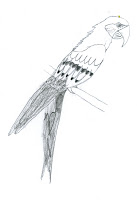
Gorgeous, huh?
Then we dedicated the book to our French-Australian friends, The Short Family, who have voyaged back and forth across the oceans as much as we have.
So, this book, little as it is, ended up being quite a special one for me.


Sunday, January 9, 2011

Short stories and blue-speckled eggs

I have a children's story in the Sunday Age newspaper today.
I love short stories. I wrote short stories for years before I even considered embarking on my first novel. They are how I learned to write. As a young mother in the suburbs (nearly eighteen years ago!), they were my little windows of creativity. My eldest son had long afternoon sleeps as a baby - sometimes up to three hours. I would carry an idea for a story around in my head all morning while I did housework or shopped or attended to his needs. Then, the minute he was asleep, I would rush to my computer and the story would spill out of me like a fever. I trained myself to write 3000 words in two hours. They were my lifeline. Dozens and dozens of them were written over those years. Some of them stored on floppy disks (remember them?) that can never be retrieved. But that doesn't matter. It was the act of writing that was most important - not the outcome.
I continue to write short stories just for the pleasure of it. And the training they give me as writer. Those short sharp episodes. The practice of efficiency. Glimpses into a lit window, then off again. Occasionally, if I'm asked to provide a story for a publication, I might pull out one of those stories, dust it off. Rework it or shorten it or lengthen it depending on the required word count. None of the stories, that writing practice, is ever wasted.
Over the last few years, The Sunday Age has asked me to provide a children's story for their summer edition. The deadlines are always tight, the stories always need to be written in that frantically busy period just before Christmas, and I always wonder if I'll be able to come up with something in time. Then, when I create that little space in my busyness, sit down and begin, I am reminded all over again what a joy writing short stories can be. Occasionally I might be given some guidelines: word length, themes, but these boundaries only stimulate my imagination all the more - give me something to press against.
Then, of course, there's the excitement of seeing my story in the paper. Of course I buy copies for my parents, too. I don't know if the excitement of seeing my name in the paper will ever wear off. But even more exciting are the letters that come afterwards from my young readers. For two of my short stories, the letters I received were so inspiring that I was encouraged to turn them into children's novels. One of them became a Penguin Chomp titled, 'Just One Wish'. The other is the basis for my latest novel, 'Angel Creek', due out in February.
So, for those of you, who don't receive The Age newspaper, I have posted today's story below. If I can find them all, I will post the other stories over the next few weeks.

The Egg-Sitter.

Did I ever tell you about the time I found an egg in my garden? No, not a bird’s egg. Nothing like that. Much bigger. The size of a watermelon and covered in pale blue spots. Right in the middle of my veggie patch. While I was standing there looking at the egg, wondering where it had come from, and what clumsy critter had trampled all over my tomato plants, there was a knock on my front door.

I wasn’t expecting anyone. It was that dead time between Christmas and New Year and finally I had some peace and quiet to work on my novel. Instead I was distracted and disturbed by that egg. And now an unexpected visitor. I opened the door.

‘Ahem,’ came a gruff voice. ‘Someone called about an egg?’

I looked down and there, standing on my front door mat, was a stout little man in a three-piece suit. Only as high as my knee. Standing there looking up at me, his hands crossed over his round belly.

He cleared his throat again. ‘Erhm…the egg?’

‘Oh!’ I said, startled out of my staring. ‘Um, yes, I do have an egg, as a matter of fact. It’s out the back.’

He followed me through my kitchen and into the garden. ‘Who told you it was here?’ I asked him.

‘Sorry, Madam. I don’t get given that kind of information. Just get told where my next job is.’

He handed me a crisp white business card, with gold lettering.

It read:

Poulterkin and Sons

Egg-sitters since 1801

No egg too big or too small

And, sure enough, when I looked up from the card, the little man was climbing up onto the egg and making himself comfortable.

‘So… ‘ I said. My day was getting stranger and stranger. ‘You’re here to sit on that egg…’

‘Until it hatches.’

‘Until it hatches. Of course. How long exactly do you think that will take?’

The little man shrugged. ‘Hard to tell, really.’

‘Right. Well. Are you okay if I get back to work then?’

‘Don’t mind me,’ he said. ‘Just pretend I’m not here.’

But this proved extremely difficult. My studio looks out over the garden, and every time I lifted my eyes from the computer screen, there he was. That little man. Sitting on that big egg in the blazing sun. I sighed, pushed back from my desk and strolled outside.

‘I was thinking of making myself a sandwich and a cup of tea. Would you like something?’

‘Oh, that’s terribly kind of you. I was in such a rush to get here this morning I didn’t have time for breakfast.’

‘Great!’ I said. ‘Ham, cheese and tomato, okay?’

‘Oh,’ he said, reddening. ‘I don’t eat ham. Or cheese. And I’m not very keen on tomatoes, to tell you the truth. Would you happen to have any honey?’

‘Sure. One honey sandwich coming up.’

‘White bread?’

‘White bread. How do you take your tea?’

‘White with ten.’

‘Sorry?’

He blushed again. ‘I know. I should be cutting back on milk. But I’ve got a long day ahead of me.’

I made the tea and sandwiches and we sat in my garden chatting. Turns out he was a keen gardener. I admitted I’d never had much luck with tomatoes. Put them in every summer but they were always disappointing.

‘So, what’s in there?’ I asked, finally. ‘I mean it’s much too big to be a bird’s egg.’

‘Oh, no, no!’ He chuckled. ‘We leave bird eggs to the birds. They’re perfectly capable mothers.’

‘Well, what then?’

He looked down at his hands. ‘Sorry, dear. Top secret. Part of the job, I’m afraid.’ And he made a gesture like he was zipping up his mouth. ‘Thanks for the tea, though. Now, if you’ll excuse me…’

That afternoon I rearranged my bookshelf and sorted through my filing cabinet. I was far too distracted to work. Every now and then I’d glance out the window of my studio towards the vegetable patch and see the little man perched on the big blue-speckled egg. Occasionally, he’d nod off, but most of the time he just gazed peacefully up into the birch trees. I finished up and wandered outside.

‘I’m going to start thinking about dinner soon,’ I told the little man. ‘I don’t suppose you’d like to come in and join me?’

The little man’s eyes widened. ‘Oh no! I couldn’t leave the egg. Especially now it’s getting cooler.’

‘Can I bring you something then? Some dinner?’

‘Just a cup of tea, would be lovely. Thank you. But can you make them heaped teaspoons this time, please? I like my tea sweet.’

And so it went on. All that night and all the next day. All the next day and the next. The little man sat on the egg. Rain, hail or shine. I took him cups of tea that were so sweet you could almost stand a spoon up in them, but apart from the honey sandwiches, that was all he ate.

I grew to admire that little man, I have to say. I’ve never seen anyone with such patience. And I think he grew rather fond of me, too. When the weekend came around, I was faced with a dilemma. Friends had invited me down to the beach to celebrate New Year’s Eve, but I was loathe to leave him on his own. I knew I wasn’t the greatest company, but I guessed I was better than no one.

‘Go, go. Of course you must,’ he insisted. ‘It’s not healthy for someone your age to stay cooped up all summer with only an old egg-sitter to chat to.’

So, I drove down to the beach. I tried to join in the fun, the conversations, the festivities. The fireworks that year were the biggest they had ever been. But I couldn’t help thinking about the little man and worrying about him all on his own. The next morning, I got up before anyone else was awake. I drove all the way back to the city without stopping. The streets were quiet and litter was strewn everywhere.

‘Hello?’ I called as I unlocked the front door. ‘Hello?’ I strode through my kitchen and out the back door. ‘I’m home.’

But he was gone.

Where he had sat day after day was a small tomato plant, already brimming with tomatoes. When they ripened, everyone said they were the best tomatoes they’d ever tasted. Which was just as well, because all the bushes I’d planted had been squashed flat. And leading out of the veggie patch, up the garden path were the biggest footprints I’d ever seen. Big three-toed footprints that sunk deep into the earth.


Monday, December 27, 2010

Look! draw a story competition.

Recently, I have had the extremely pleasurable (but also extremely difficult) task of judging the first round of winners for the Look! draw a story competition, along with author/illustrator Anna Walker and author/publisher Jane Godwin. Each month from December to April there will be another line of the story released for children to illustrate and a winner will be chosen from three age groups. Have a look HERE at some of the entries so far - and you'll see why it was so hard to choose a winner!


Saturday, December 18, 2010

Fairytales: not for children!

Last night I watched the movie of 'To Kill a Mockingbird'. Even though I first read this book at school (many years ago!), I hadn't realised until watching the film again last night how much of an influence this story has had on me. As a writer, when I think of the books that draw me to them the most, they are often narrated by a child protagonist and give a child's perspective on a fairly grim world. 'I'm Not Scared' by Niccolo Ammaniti, 'The Book Thief' by Markus Zusak, 'Jasper Jones' by Craig Silvey and 'Carry Me Down' by MJ Hyland are classic examples of these, though if I put my mind to it I could think of at least a dozen more. I am fascinated by the mix of childhood innocence with the bleakest aspects of adult life: the result for me being the most starkly contrasting shades of dark and light possible. (There are movies that do this for me, too: the recent German film 'The White Ribbon' and the 1955 film 'The Night of the Hunter' being two of my favourites.)
There is a scene in 'To Kill a Mockingbird' where a lynch mob arrives in the night to break into the prison where lawyer, Atticus Finch, is guarding Tom Robinson, a black man, who is held in there for supposedly raping a white girl. Atticus' six-year-old daughter, Scout, recognises one of the men in the crowd as the father of a school friend of hers and blithely chats with him about his son, which eventually shames him into calling the mob away. This is such a powerful example of childhood goodness and innocence overcoming adult bigotry and cruelty; light overcoming dark. For me, this is also the essence of so many traditional fairytales: the innocent Red Riding Hood vanquishing the wicked wolf.
Interestingly, when I started to look up some of the details of this book and its author Harper Lee, online, I read an article which finished with the words: 'a book every twelve-year-old should read'. This is another area I feel compelled to explore: why is it that if a book has a young protagonist in it adults immediately assume that it's for children?
Like many teenagers, I read 'To Kill a Mockingbird' in high school. I was a 'good reader', I had no trouble absorbing the words, but the story was so far from my comfortable middle-class Australian world that I only realise as an adult how little of it I really understood. As a teenager, I was hungry for Judy Blume: stories of boyfriends and periods and pimples, THAT was my life, not 1930s Alabama. Of course I could feel empathy for Scout, Atticus, Boo Radley and Tom Robinson, I wasn't completely heartless, but it is only upon rereading this book as an adult that I can truly understand the whole historical and social context of the story. As a twelve-year-old? I doubt it.
Perhaps I was particularly narrow-minded or naive as a teenager, but having travelled extensively all throughout my childhood, I would be surprised if I was more so than any other teenager of my generation. Perhaps teenagers today, with access to the internet, are more worldly, who knows? All the same, I would hesitate to call 'To Kill a Mockingbird' a children's book. Or any of the other books I've mentioned above.
I recently gave a talk at a seminar for adults who teach extra classes in English to children after school hours. Many of those children and teenagers have English as a second language. One of the tutors put up her hand to ask me how she could get one of her teenage students to read more 'literary' novels. She'd tried him with 'Huckleberry Finn', but he just wasn't interested. I explained that I'd only recently read Huck Finn for my book group. As an adult. Huck Finn was no light read. For a start, the dialect and language, while fascinating to me as an adult, could seem possibly Shakespearean to a young boy. And, while it's true that Huck has many wild adventures, essentially the story is about a black slave trying to escape from his 'owners' to get back to his family and avoid being killed. There are some incredibly adult themes in this book, yet because it is narrated by a child people assume it is a children's book.
I suggested to the woman to perhaps try some contemporary Australian authors: we have some brilliant writers here writing stories for contemporary teenagers. He might find them more relevant to his every day life. Her student would seek out Huck Finn for himself when he was ready for it. As well as all those other brilliant books we are made to study in high school: Lord of the Flies, Brave New World, My Brother Jack. I mean, how as a sixteen-year-old girl was I possibly able to understand the life of a unhappy journalist lusting after his brother's wife when I hadn't even experienced a long term relationship, let alone a marriage?
I'd really be interested to know what other people's thoughts are on this. I notice many of these books are still studied at school in place of contemporary YA fiction, some of which is as well written as any of the 'classics'. Then again, perhaps if we never studied the classics at school we'd never read them at all? Who knows? And, while I acknowledge I could have only understood some of the themes present in these books, I am the first to admit that the stories still stay with me today, gently unfolding in my mind as my collective life experience permits me to understand them at deeper and deeper levels.
So, perhaps in the end to call books 'children's', 'YA' or 'adult's' doesn't mean anything anyway. Adults read Harry Potter and enjoy it and primary school kids read Twilight (gulp!). Perhaps you just find the story that speaks to you. Perhaps you understand as much of it as your life experience and compassion allows you. And perhaps, like 'To Kill a Mockingbird' has done for me, it will continue to influence you long after you've read it, and each time you go back to it you will understand it at a deeper level.
After all, when they were first told around the fireplace, fairytales weren't meant for children either.

Monday, December 13, 2010

Ahem. And what about the kids' books?

I have noticed quite a few bloggers are listing their favourite YA books for 2010, or the ones they are looking forward to reading this summer (for southern-hemisphere dwellers)*

So, I thought I'd put a good word in for the kids' books - as I do think they get a little overlooked in blogsphere. (Which might have something to do with the fact that 8 year olds aren't all that big into blogging. Yet.)

Here are some of the fabulous children's books I read in 2010:
- 'When You Reach Me' by Rebecca Stead (I know some people are claiming this as YA - but I'm sorry, I'm going to shelve this in the kids' section - so there!)
- 'People Might Hear You' by Robyn Klein (Not a new book, I know, but wow! Thanks Kim Kane for insisting I read it.)
- 'James and the Giant Peach', 'The Magic Finger', 'The Witches' - basically anything by Roald Dahl. (What a joy to read them to my seven year old this year and be reminded what an incredible storyteller RD is - and how it's OK to be scary and subversive when you're writing for kids. The illustration above is by one of my favourite illustrators, Quentin Blake. He and Roald Dahl go together like pudding and custard.)
- 'Diary of a Wimpy Kid' series, by Jeff Kinney - I was so prepared not to be impressed by these. How much do I love to be proven wrong! I defy anyone of any age not to laugh when they read these books.
- Anything by AA Milne - I read these regularly to remind me how beautiful language can be.
- 'The Naming of Tishkin Silk' by Glenda Millard. What a gorgeous family - I can't wait to read the rest.

Some great Australian children's books by on my bedside table that I am looking forward to reading over summer:
- 'The Museum of Mary Child', by Cassandra Golds
- 'Teensy Farlow and the Home For Mislaid Children', Jen Storer
- 'Star Jumps' by Lorraine Marwood

And some classics I have recently bought that unbelievably I STILL haven't read:
- 'A Wrinkle in Time', Madeleine L'Engle
- 'Bridge To Terabithia', by Katherine Paterson
- 'The Wolves of Willoughby Chase', by Joan Aiken
- 'The Moomintroll' series, by Tove Jansson

That's all I can think of for now - though I'm sure I've missed dozens. Any good kids' books I've overlooked? Old or new? I'd love some suggestions. What were your favourite books as a kid? Or now?

Also, I was most thrilled to see my book 'Angel Creek' on a couple of bloggers lists for most anticipated YA read for 2011. For all those lovely people: I have a small confession to make. While of course I would love you to read my book, I have to warn you it is absolutely NOT YA. Very squarely children's, I'm afraid. I know it is confusing because the last book I published with Text is YA, but this one is not. Not one bit. All the same, I'm very touched that someone is/was looking forward to reading it!

And anyway - YA, kids, chick-lit, sci-fi, fantasy: they're only labels so that publishers and booksellers know how to market a book. A good story is a good story, I say.


*For any northern-hemisphere readers of this blog: yes, sadly, many of us do spray fake snow on our windows and eat a full roast dinner in 35+ degree heat, down here in 'upside-down land'. Guess you can take the girl out of England but not England out of the girl, hey?


Friday, December 10, 2010

Hello Summer!

I love summer. Everything about it. The heat, the cicadas, the fruit on our trees, the tomatoes in our veggie patch, daylight saving, and especially that quiet time between Christmas and New Year, where everyone is away, or thinks you're away, or they're just too hungover to surface.
Last summer was a very creative and productive time for me. Over those few quiet weeks I wrote the first draft of my novel, Angel Creek. By the end of this summer it will be published.
This summer will be a little busier - I have more Billie books to write and the proofs of my novel to go through. I am also writing a children's story for the Summer Age which will be published in January some time. Not sure when.
Late summer, I will be running Chinese painting workshops for kids on the 13th and 20th of February at the State Library as a part of their exhibition 'Look! - the art of Australian picture books today.' If you are at all interested in children's picture books, particularly illustrations, you have to get down to see this show. It is truly wonderful. And take a child, if you can. All the artwork is hung at child height, and the exhibition space is full of hands-on activities and games, which of course you'll feel much more comfortable playing with if you have a token child with you. (I have a few spare if you don't have your own.) You have plenty of time to get there as it will be in Melbourne until the end of May, but seriously, why would you wait in the queues to see the Myer windows with screaming kids in tow when you could just wander up the road and take a look at some seriously beautiful artwork for children. (Sorry, that's just my humble opinion...)
The image above is of my 'Summer Billie'. It will be in (all good) bookstores in January.

Friday, December 3, 2010

Save Collected Works - pass it on! (thanks Kirsty Murray)


Thanks Kirsty Murray for alerting me to this. I thought I'd post it too, just to get it out there as far as possible. Collected Works is such an important Melbourne institution. It would be terrible if it closed down. Show your support and pop in there this week. I used to have a studio in the Nicholas Building just down the hall from this wonderful bookstore and have very fond memories of afternoon cups of tea and wonderful conversations with the owner, Kris Hemensley. He was even kind enough to launch my book 'Becoming Buddha' many years back. Just as Kris has always shown his support for the Melbourne writing community by stocking small press books, backlists and, of course, shelves and shelves of poetry, let's return the favour by supporting him in return. If you can't get in this week, drop in when you can. Here are the details of where to find him. And you'll get a chance to have a peek into the marvellous Nicholas Building, another Melbourne icon, while you're there! (Click on the images to enlarge.)